
Door Desks and a Garage: How Amazon Started
Jeff Bezos began Amazon in a rented Bellevue house, in a garage with no insulation, at a desk made from a door. Here is the full story, with the numbers.
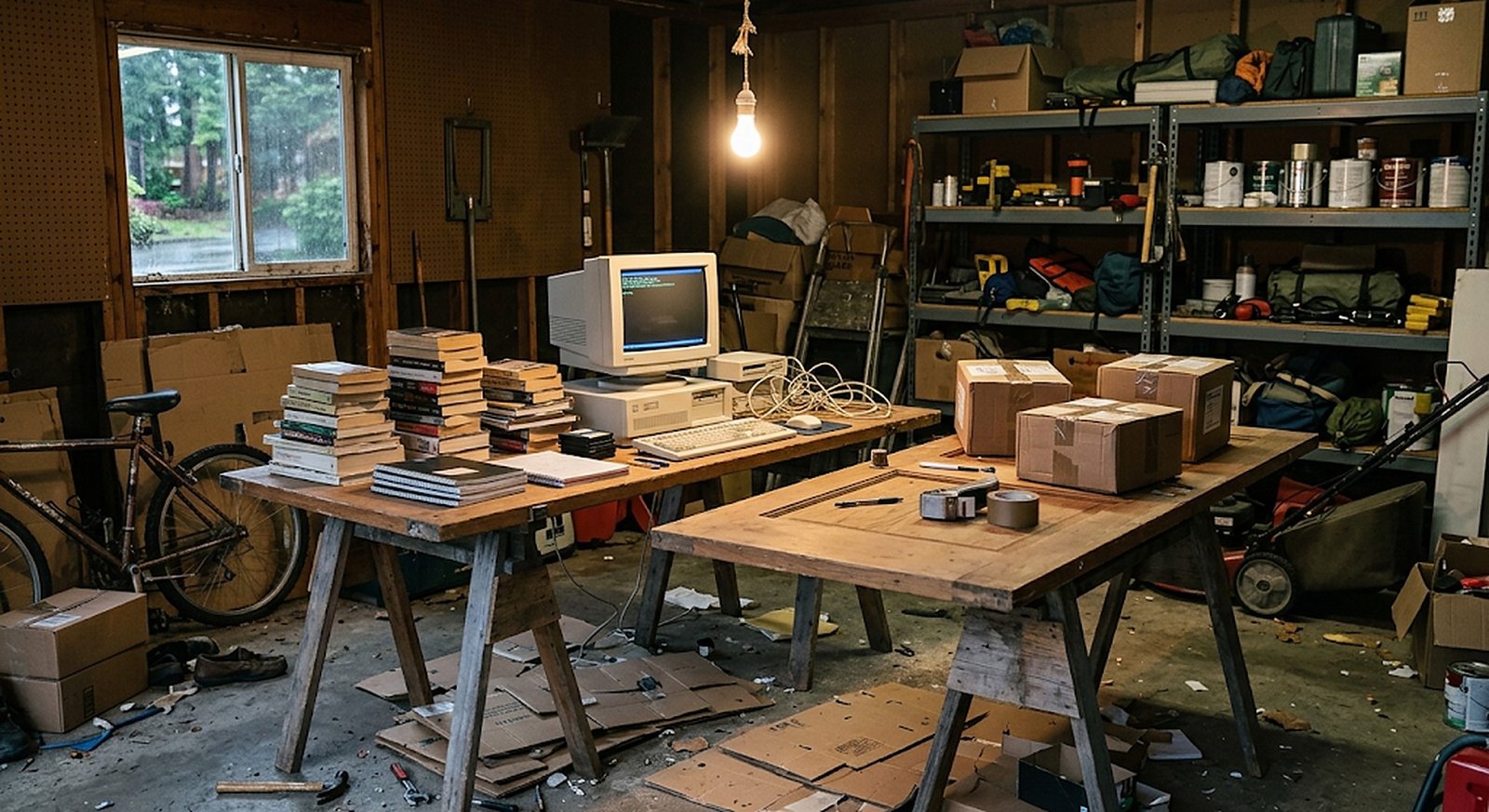
Amazon now sells almost everything. But how Amazon started looks small and a little silly: a rented house in Bellevue, a garage that was not quite a garage, a desk made from a door, and a company name that a lawyer heard as “cadaver.” Jeff Bezos made a big personal bet, but he kept the business cheap: no shop, almost no stock and desks from a hardware store.
A number, a list and one winner
In 1994 Bezos was 30 and a vice president at D. E. Shaw, a New York hedge fund. He studied online business, and one figure stuck: web usage was growing 2,300 percent a year. He wrote down 20 products that might sell online, including books, music, magazines and PC hardware and software, then cut the list to books and music.
Books won for two reasons, Fortune reported in 1996: more titles (about 1.3 million in print against 300,000 for music) and no giants. The biggest chain, Barnes & Noble, held under 12 percent of a $25 billion market.
To leave a high-paying job, he used what he later called a regret minimization framework: at 80, he expected to regret not trying more than failing.
A map drawn with three rules
Next came the place, and how Amazon started in Seattle was no accident. Bezos had three rules. Technical talent had to be nearby. The state needed a small population, because only its residents would be charged sales tax, which ruled out California. And a big book wholesaler had to be close.
His shortlist was Portland, Boulder, Lake Tahoe and Seattle. Seattle won. The University of Washington trained programmers, Ingram’s largest distribution center was a six-hour drive away in Roseburg, Oregon, and his friend Nick Hanauer urged him to come. Bezos and his wife, MacKenzie, flew to Texas, where his father gave them a 1988 Chevy Blazer. MacKenzie drove west while Bezos typed a business plan on a laptop and raised seed money on a cell phone.
How Amazon started as Cadabra
The company was incorporated in Washington in July 1994 as Cadabra, as in abracadabra. Bezos gave the name to a Seattle lawyer over the phone, and the lawyer asked if he had said “cadaver.” That fall, after reading through the A section of the dictionary, Bezos switched to Amazon. The river suggested something huge, and the first letter helped, because websites were listed alphabetically.
Five days after arriving in Seattle, he and MacKenzie rented a three-bedroom ranch house in Bellevue. It needed a garage, because Bezos wanted to say he started in one, like Hewlett and Packard. It was no longer a real garage, though. It had become a family room with a linoleum floor. He joked that it counted a little anyway, because it had no insulation.
A door from Home Depot
Shel Kaphan, the first programmer Bezos hired, worked in that room. Paul Barton-Davis joined Kaphan in October 1994 and remembered his first visit: one server, a desk made from a door and a pile of business books.
Nico Lovejoy, an early employee, remembers that Amazon sat across the street from a Home Depot. Doors cost far less than desks, so Bezos bought one and added legs. Lovejoy called Bezos’s desks wobbly. By late 1996, Fortune noted that many desks were unfinished doors laid across sawhorses. Amazon later made the door desk a symbol of frugality, with a Door Desk Award for ideas that lower prices.
Family money helped. In 1995 Bezos’s parents invested $245,573, according to Bloomberg, after he told them there was a 70 percent chance they would lose it all.
A store with nothing on the shelves
Here is how Amazon started selling. The site opened in July 1995, and as late as 1996 Fortune noted there was no storefront and little inventory. When a customer ordered, Amazon requested the book from a distributor, packed it on arrival and shipped it.
Distributors wanted orders of ten books at a time, and Amazon sold far fewer. Bezos later told the fix himself. Their system only required ordering ten, not receiving ten. So Amazon ordered the one book a customer wanted plus nine copies of an obscure lichen book that was out of stock. The distributor shipped the single book with a note saying sorry, no lichen book.
The first book sold was Douglas Hofstadter’s Fluid Concepts and Creative Analogies. A beeper announced each order until orders came so fast the team switched it off. By the end of the first month, books had gone to all 50 US states and 45 countries, and everyone packed on hands and knees on a concrete floor, software engineers included. Bezos suggested knee pads. The engineer next to him said they needed packing tables. Bezos bought tables the next day and says productivity doubled.
Amazon’s 1997 shareholder letter reports sales of $15.7 million in 1996 and $147.8 million in 1997, the year it went public.
What a small business can borrow
Here is what a small business can borrow from how Amazon started:
- Start with a setup you can afford to lose. A rented house, a door for a desk and one server were enough to begin.
- Order stock after the sale. In 1996 Fortune reported a return rate under 0.25 percent, against about 30 percent for the industry.
- Choose a location with a checklist. Bezos weighed talent, sales tax and supplier distance. Tax rules have changed since 1994, so check today’s.
- Fix the cause, not the pain. Packing tables beat knee pads.
- Be honest about the odds. Bezos told his parents they could lose everything.
That is how Amazon started: small, cheap and easy to test. Want an idea you can test the same way? Browse our business ideas.
Sources
- The Seattle Times: “Homegrown Amazon,” Robert Spector, 2000
- Amazon: “Amazon recreated the garage where Jeff Bezos started the company”
- Fortune: “The Next Big Thing: A Bookstore?” Michael H. Martin, 1996
More stories
$538 and a Garage: How HP Started
Two Stanford-trained engineers began in 1938 with $538, a used drill press and a Palo Alto garage. Then Disney ordered eight of their oscillators for $572, more than their starting capital.
5 min readBeating Piracy at Its Own Game: How Spotify Started
Two Swedish founders, a free service the record labels disliked and a bet that a legal app could beat music piracy: how Spotify started.
4 min readFrom a Car Trunk to a Waffle Iron: How Nike Started
A school paper, two founders with $500 each, a ruined waffle iron and a $35 logo: how Nike started from the trunk of a car.
Ask a question or share your experience