
$538 and a Garage: How HP Started
Two Stanford-trained engineers began in 1938 with $538, a used drill press and a Palo Alto garage. Then Disney ordered eight of their oscillators for $572, more than their starting capital.
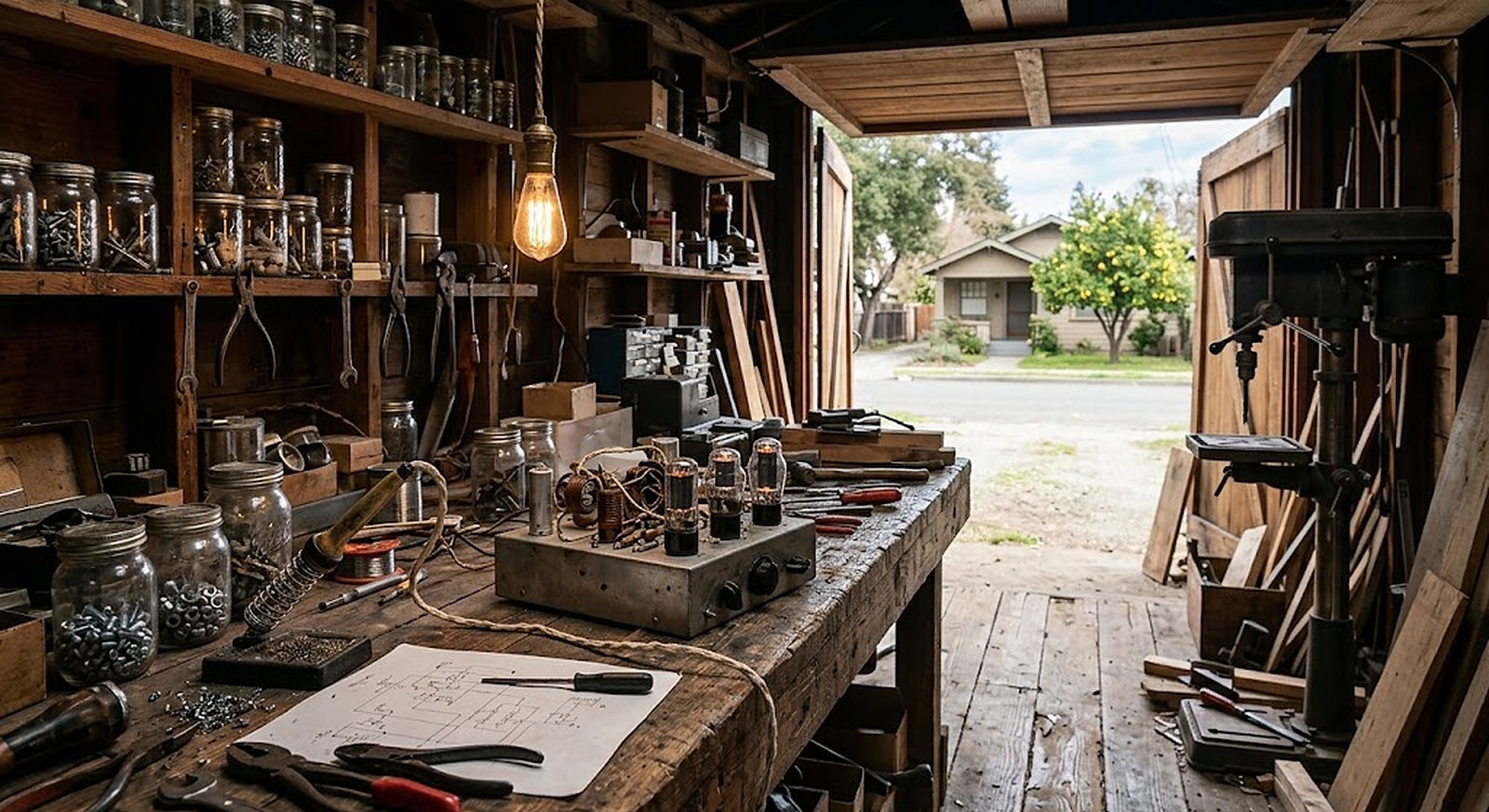
In 1938, Bill Hewlett and Dave Packard had $538, a used drill press and a garage in Palo Alto. Soon after, one customer order was worth more than their entire starting capital. This is how HP started: not with a plan for computers, but with a cheap, well-made test instrument and a customer who needed it.
$538: How HP Started in a One-Car Garage
The $538 was cash plus a used Sears-Roebuck drill press, which rode to California in the rumble seat of Packard’s car. Both men had studied electrical engineering at Stanford. After graduating in 1934, they took a two-week camping and fishing trip in Colorado and came back close friends. Their former professor, Fred Terman, later urged them to start a company of their own.
Hewlett found a rental at 367 Addison Avenue in Palo Alto for $45 a month. Packard and his wife Lucile took the downstairs flat, and Hewlett slept in a tiny backyard shed with room for a cot. The two men began working part-time in the garage. It measured 12 by 18 feet and held a concrete floor, a workbench and not much else.
A Light Bulb That Cut the Price
The garage turned out several small devices. A Palo Alto clinic bought a medical heat machine, one device helped astronomers at Lick Observatory set a telescope accurately, and there was even a harmonica tuner and a foul-line indicator for a bowling alley. The one that became a product line was an audio oscillator, an instrument that makes a single pure tone for testing sound equipment. Hewlett had designed it as a graduate student at Stanford.
Rival oscillators cost around $500 and were unstable. Hewlett put a small light bulb in the circuit. The bulb acted as a variable resistor and held the signal steady without distortion. That made the design simpler and much cheaper. The finished instrument sold for just under $55. The feedback idea later powered other early products, such as a wave analyzer and distortion analyzers.
They called it the Model 200A. The name was chosen so a brand-new company would look established, with a whole product line behind it.
Eight Oscillators, $572
An engineer from Walt Disney Studios reviewed the 200A. Disney was preparing Fantasia, due in 1940, and needed new ways to monitor its sound. The film used Fantasound, an early surround-sound system installed in select theaters. The engineer asked for changes, and the modified version became the Model 200B.
Disney ordered eight at $71.50 each. That comes to $572, more than the $538 the partners had pooled. The custom model also cost more than the standard 200A.
Disney engineers used the 200B units to test channels, recording equipment and speaker systems in the 12 specially equipped theaters that showed Fantasia in 1940. This order is the part of how HP started that people remember. It came before the partnership was even formal.
A Coin Toss and the Family Oven
After the Disney sale, the two men formalized their partnership on January 1, 1939. A coin toss decided the company name. Revenue for 1939 was $5,369.
Production stayed homemade. Lucile let them bake the paint on instruments in her oven, and the family table handled the paperwork. After Hewlett married Flora Lamson, his old backyard shed became the company office, where the two wives shared the office work in their off hours. Steady income came from Lucile’s job as a secretary at Stanford, while Packard held a university fellowship and Hewlett worked as a research assistant.
A Building That Could Become a Grocery Store
By 1940 the garage was too small. HP moved to rented buildings at Page Mill Road and El Camino Real in Palo Alto. Revenue that year was $34,396, more than 60 times the original $538. HP also paid its first employee bonus that year: a $5 Christmas bonus.
Revenue passed $100,000 in 1941. Hewlett served as an Army officer until 1947, and Packard ran the young company while he was away. In 1942 construction began on the first company-owned building, at 395 Page Mill Road. Hewlett and Packard designed it so it could be converted into a grocery store if the business failed to grow. The business grew instead, and revenue in 1942 was $522,803. That year Packard also designed the Model 400A voltmeter, which was more reliable than rival models and cheaper.
In 1987 the garage was registered as California Historical Landmark No. 976 and named the Birthplace of Silicon Valley. HP bought the property in 2000 to preserve it, and the site joined the National Register of Historic Places in 2007. The garage is not open for tours, but you can view it from the street.
What a small business can borrow
The story of how HP started has lessons you can copy on a small budget.
- Start with what you have. A rented garage, a used drill press and a backyard shed were enough.
- Build on what you know. Hewlett’s graduate work became the first product.
- Win with one clever idea. A light bulb made the instrument simpler and far cheaper than the rivals.
- Let a demanding customer shape the product. Disney asked for changes and paid more for the result.
- Look established. Even a model number can make a new company look older.
- Keep your income steady. Fellowships, a research job and Lucile’s salary paid the bills while the company grew.
- Plan a fallback. The first company building could have become a grocery store.
Looking for your own starting point? Browse our business ideas and pick one you can test on a small budget.
Sources
- HP: HP timeline, 1930s and 1940s
- HPE: HPE History
- Science History Institute: Model 200B audio-frequency oscillator
More stories
A Wooden Duck, a Fire and a Plastic Brick: How LEGO Started
A carpenter with no customers, a Danish town, two fires and a plastic brick: how LEGO started, and what any small business can borrow.
4 min read5,127 Prototypes and a Clogged Vacuum: How Dyson Started
A vacuum that kept losing suction, a cyclone from a sawmill and 5,127 prototypes: how James Dyson started.
4 min read$5,000 and a Pair of Scissors: How Sara Blakely Built Spanx
A fax machine salesperson, a drawer full of unusable pantyhose, and an idea nobody in the industry had tried.
Ask a question or share your experience