
A $5,000 Loan and No Coffee Drinks: How Starbucks Started
Three friends, a $5,000 bank loan and a hand-built shop that sold beans, not coffee drinks. Here is how Starbucks started in Seattle in 1971.
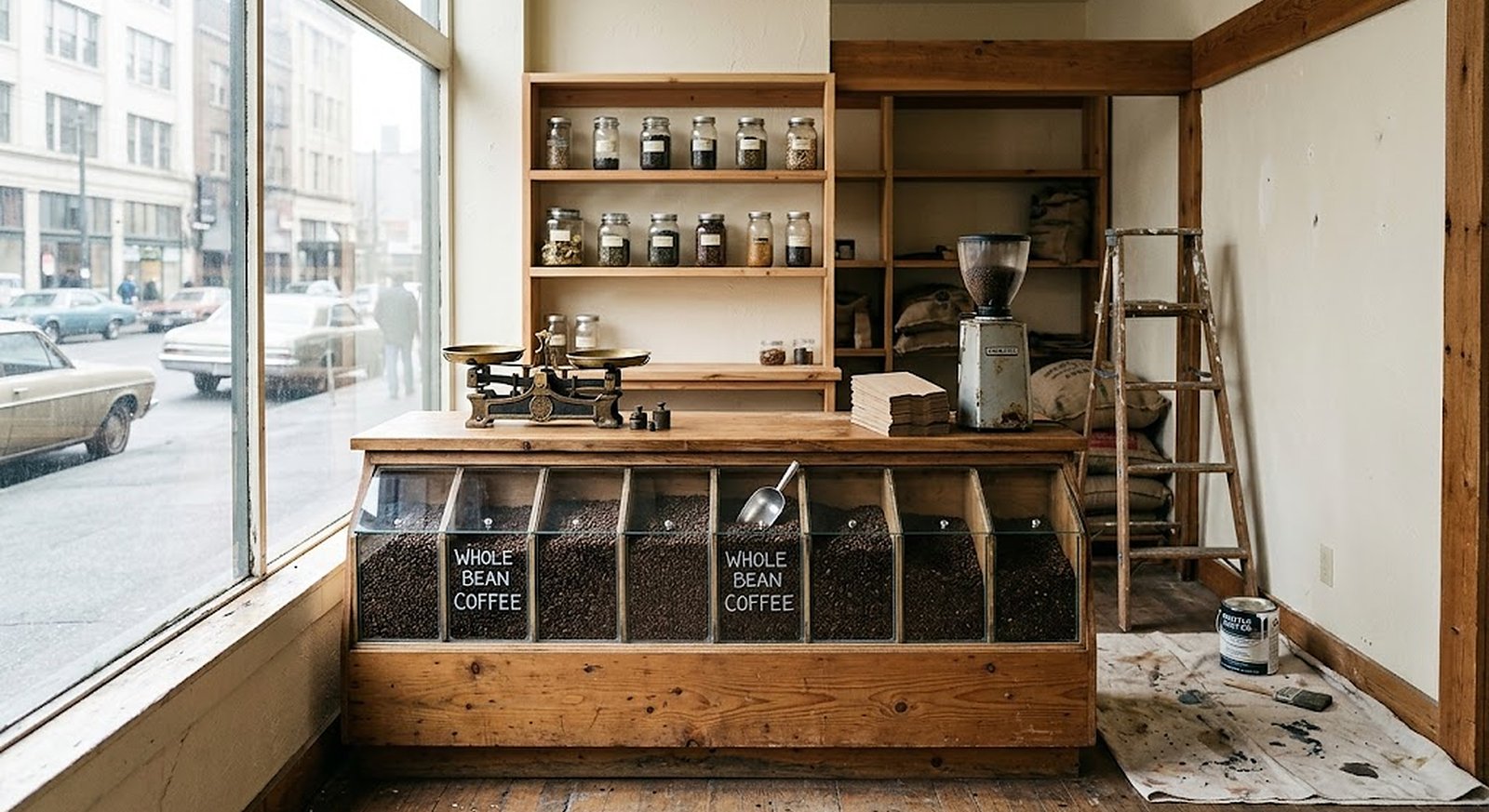
How Starbucks started is a story about a $5.36 check. On the morning of March 30, 1971, a friend of the owners, Dan Chasan, walked into a new shop at 2000 Western Avenue in Seattle and became customer number one. The owners brewed him a free sample cup, scooped Sumatra beans from a glass-fronted bin and let him smell them. He bought a pound of Sumatra at $1.75, added some tea and wrote the check. There was no latte and no espresso bar, only the free sample.
A Failed Film Company and a Bad Cup of Coffee
To see how Starbucks started, begin with three friends and a venture that sank. Jerry Baldwin, Gordon Bowker and Zev Siegl had known each other since the early 1960s. They tried writing screenplays and making recorded classical-music shows for radio. Baldwin and Bowker also planned a documentary film company called Pequod, after the ship in Moby-Dick. It sank without a trace.
The coffee idea came over lunch and a bad cup. Bowker had been driving to Vancouver, B.C., to buy good beans, and his friends kept placing orders with him. Siegl did the research. He found a gourmet coffee company in Berkeley, Peet’s, phoned Alfred Peet and visited him in December 1970.
$5,000 From a Bank and $137.50 a Month
Each partner put in about $1,500, and a bank lent them $5,000 more. Starbucks’s own history says $1,350 each, so sources differ. The shop was a corner storefront in the old Harbor Heights Hotel at 2000 Western Avenue, just north of Pike Place Market. Rent was $137.50 a month.
The timing looked bad. Seattle was in the Boeing Recession, houses stood empty on Capitol Hill and a billboard asked the last person leaving town to turn out the lights. The upside was cheap space.
The owners built the shop themselves. The counter, bins and shelves were made in Siegl’s parents’ basement. Baldwin did the wiring and Bowker painted. The space had housed a junk shop for years, so they hauled out about 90 cubic yards of trash before they could clean it.
How Starbucks Started Selling Beans, Not Drinks
The first store sold coffee by the pound. It also carried tea, spices, coffee makers, grinders and teapots. The only brewed coffee was free. Siegl later explained the logic: a sample got visitors talking and kept them in the store while the owners scooped beans and held them up to smell.
The beans came from Alfred Peet’s store in Berkeley. Baldwin and Bowker had each spent time there learning the trade, and Peet agreed to supply fresh-roasted beans. The name came from an old mining map on Bowker’s office wall. He spotted a town called Starbo and thought of Starbuck from Moby-Dick. The failed film company and the coffee company took their names from the same novel.
Publicity cost almost nothing. Bowker, who worked in advertising, mailed a fragrant package of coffee to Don Duncan, a Seattle Times columnist. Duncan visited, tried the free samples and wrote an enthusiastic article. One Saturday the weekly shipment from Peet’s did not arrive. The owners took orders from every customer in the store and delivered one-pound bags by car the next week.
$46,832 in the First Nine Months
In its first nine months, the shop grossed $46,832. After expenses, little was left. Siegl was the only paid employee. Baldwin and Bowker kept their day jobs, and all three worked the counter on Saturdays. Each took the job he did best: Bowker handled publicity, Baldwin handled money, tasting and buying, and Siegl took charge of tea.
In 1972 a second store opened at University Village. The partners were broke and asked friends for money. Peet then told them to roast their own beans. He helped them find a used roaster and taught Baldwin the dark roast Starbucks became known for. They rented a warehouse near Fishermen’s Terminal to do the roasting.
From a Brazilian Freeze to a $3.8 Million Sale
Growth was not smooth. In 1975 a freeze wrecked much of Brazil’s coffee crop. Prices jumped, sales dropped and Starbucks stopped giving away free samples. In 1976 the old hotel was torn down, and the flagship store moved half a block south to 1912 Pike Place, the shop many visitors call the original.
The first Starbucks that sold brewed coffee opened in 1982, eleven years after the first. Howard Schultz joined as marketing director that year. After a 1983 trip to Italy he pushed for espresso bars, and the first one opened in downtown Seattle in 1984. In 1987 Bowker decided to sell his stake (Siegl had left in 1980). Baldwin chose to keep Peet’s, which Starbucks had bought in 1984, and put Starbucks up for sale. Schultz and a group of investors raised $3.8 million and bought it.
What a small business can borrow
A small business can copy a lot from how Starbucks started:
- Start with a simple product. Starbucks sold beans for eleven years before it sold a brewed cup.
- Let people try before they buy. Free samples turned visitors into talkers and then customers.
- Find a mentor. Alfred Peet shared his knowledge, supplied the beans and later told the founders to roast their own.
- Build it yourself and rent cheap. Hand-built counters and a low-rent storefront kept the first costs down.
- Keep a day job while the shop finds its feet. Only one of the three owners took a salary at first.
- Fix problems with service. When a shipment was late, the owners took orders and delivered by car.
A small loan, a hand-built counter and a free sample did the work. Looking for a starting point of your own? Browse our business ideas.
Sources
- HistoryLink.org, “Starbucks: The Early Years” by Sheila Farr
- HistoryLink.org, Essay 2075 by Sheila Farr, on the opening day of March 30, 1971
- About Starbucks, “Our Founders”
More stories
A Wooden Duck, a Fire and a Plastic Brick: How LEGO Started
A carpenter with no customers, a Danish town, two fires and a plastic brick: how LEGO started, and what any small business can borrow.
4 min read$5,000 and a Pair of Scissors: How Sara Blakely Built Spanx
A fax machine salesperson, a drawer full of unusable pantyhose, and an idea nobody in the industry had tried.
4 min readFrom a Car Trunk to a Waffle Iron: How Nike Started
A school paper, two founders with $500 each, a ruined waffle iron and a $35 logo: how Nike started from the trunk of a car.
Ask a question or share your experience